
Into the Unknown with Oliver Johnson
03 Tuesday Feb 2026
Written by Charles Harris in Books, Interviews, Novels, Thriller

Thriller writer Oliver Johnson speaks to me about writing, editing and dreams
TEN MINUTE READ
Listen to the full interview or read the edited transcript below.
I was looking forward greatly to interviewing Oliver Johnson. We were on a panel together at CrimeFest and I discovered he has a finger in many pies.
He co-authored the groundbreaking role playing game dragon warriors. Wrote two of the Golden Dragon game books, Lord of Shadow Keep and The Curse of the Pharaoh, several other games and tie-in books, along with the adult Lightbringer trilogy, a dark, epic fantasy praised as ‘hauntingly atmospheric and utterly compelling.”
He’s also a commissioning editor for Hodder and Stoughton. And he has a new thriller novel out – the excellent Caller Unknown. Do check it out.
So my first question to him was: what ties all these together, if anything?
Oliver Johnson: A lot of imagination. I began in the role playing world, which, I’ve been a big fan of since university.
I wrote a fantasy trilogy, the Lightbringer series about 30 years ago now. Then decided to concentrate on the day job, young family and so forth. However, one day, on holiday in Maine. I had a dream.
It was the dream of being in a log cabin at the end of a dead end road in the middle of a wilderness – which is where I was at the time – and some bad guys arriving in government sedans down this long, dusty road between the pine trees.
And feeling trapped. And what I would do when there’d be no, possibility of escape?
Working backwards
So I had the beginning of the end of the novel. And like you, Charles, in your excellent Room Fifteen, I wanted my hero to be suffering amnesia. So like my hero, I had to remember what I’d forgotten. And so I started composing the book backwards.
I was listening to Rachel Maddow’s podcast, Ultra: basically it’s the story of the right wing in America before the war, and how McCarthyism extended it after the war. So, I found my bad guys.

They’re called, the Christian Front. They were extreme right-wing Roman Catholics who hated Jews and hated Bolsheviks. Their idea was to have an armed uprising against Roosevelt. Twenty or more were actually put on trial for sedition. So I took that idea and extended it.
The hero, Ed Constance is one of a group of kids who have been indoctrinated, brainwashed to do some terrorist act, to spread unrest, to spread angst, to ultimately bring down the government. Basically it’s a chase story. A guy realizes he’s set up to do terrible things. He goes on the run, he assumes a new identity. Will the bad guys ever catch him up?
Writing Process and Story Structure
CH: Interesting. In Room Fifteen, I started at the beginning, with my amnesia protagonist. You started at the end.
Oliver Johnson: Did you know where you were going?
CH: I had a sense. It took me a long time to work it through, but my initial theme was how we first realise in growing up we’re not who we thought we were. And that we are actually different, more fallible, more flawed than we imagined. I wanted a person in that situation to have amnesia and have to learn what kind of person he really was.
And in fact, I changed the ending more than once.
Oliver Johnson: Did you understand the ending of my book?
CH: Yes. And I also noticed that you deliberately left a door open for the sequel. Rather clever.
And what I liked about the book was it was constantly surprising. Most books I read are predictable from the beginning. Yours was unpredictable from the beginning and there were surprises all the way through. It goes in a direction you’re just not expecting. I like this in a book.
Early Life and Entry into Writing
CH: So tell us a bit about your background. How did you get into all this?
Oliver Johnson: I was born in France. I couldn’t speak English till I was about four when I came over. And I was a bit of a solitary boy as you can imagine when I arrived in Britain.
Having to learn English, to be frank, they thought I was a bit educationally back. And, I think I turned in on myself slightly in that slightly soloistic way, enjoying reading and so forth.
Studied English at university. And, I was a complete bibliophile. I spent half my days just browsing books in Oxford, in Blackwell’s, and, all the rest of it. At this moment I met a group of people who were into role-playing games.
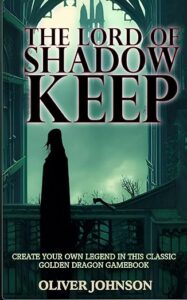
Out of this era came the fighting fantasy craze. And we were invited to write some books. And in fact I worked for Warhammer. I wrote lots of articles for their in-house magazine.
Then we started writing these “Choose Your Own” books. We had our own series, invented a role playing system, and then out of that I started writing adult fantasy books.
I don’t know if you ever had a passion for a type of literature and it waned or, the world changed and you changed with it.
But I had this idea for a thriller and it excited me a lot. So that’s why I’ve moved to this genre. And I’m writing another book also, which is not a sequel, it’s a prequel.
The Challenge of Consistency
CH: So do you think role playing games or being an editor has influenced your writing at all?
Oliver Johnson: The RPG certainly. Being an editor is a different skill to writing. It’s a completely different thought process.
Being an editor, you almost know too much. There’s no mystery, there’s no glamour. It’s all quotidian, what you do every day. So there’re not really any surprises. And I don’t know, as an author yourself, given your role in the Society of Authors and everything, if there is any pleasurable mystery in the process or whether you think you know it all.
CH: I think if you’re not discovering something you didn’t know, then you’re not doing it properly. It would be very boring too.
Variety
You mentioned Lee Child earlier, before we started recording. I read one Lee Child’s. I liked it very much. I read the second one – thought, hang on, this is the same book. I couldn’t do that for nineteen or however many books he’s done.
Oliver Johnson: Not even for the success?
CH: Not even for the success. It wouldn’t be a success that would be any fun for me.
Oliver Johnson: The books I’ve read of yours couldn’t be more different.
CH: No. I do all the wrong things. I write completely different genres.
Oliver Johnson: But of course Michael Crichton did that, didn’t he? And he wasn’t too unsuccessful.
I was his editor. He was fabulously successful as a screenwriter as well. But he said, “I usually have three or four or five novels at some stage that I’m writing. And at one moment, one of those novels, I just sit down and say, I’m going to finish this one.”
And that’s why I think you get Jurassic Park and then you’d get Disclosure, for example,
CH: Shakespeare also wrote a massive variety. As did Dickens.
Revision and Rewriting
Oliver Johnson: I don’t know how much you revise your work.
CH: A lot.
Oliver Johnson: I revise mine a lot. My next book, I have just finished the second draft. And it’s quite difficult when you’ve got to the end to think: I’ve now got to go back to the beginning for the third time.
CH: Having a background in screenwriting – where 14 drafts are the norm – going back isn’t that difficult.
Oliver Johnson: Yes, of course screenplays are shorter.
CH: Shorter, but just as hard to redo. You unpick one thing and everything else falls out. It’s the hardest kind of writing. There’s nowhere to hide.
Setting the Story in America
CH: Talking of which your new book is set in America. And you are not American. I should imagine there was quite a lot of research to be done. How did that work out?
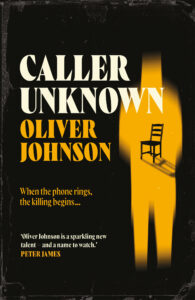
Oliver Johnson: As I said, it began from a trip to America. It’s a place I’ve gone to a lot for work. And I’ve published major American novelists like John Grisham, Crichton and Lorenzo Carcaterra. So I feel I’m quite imbued with the culture. Obviously we all watch TV.
Nevertheless, it’s not just ‘pavement’ and ‘sidewalk’ and ‘lift’ and ‘elevator.’ There’s a lot more to be considered.
I take an Ursula Le Guin approach to the language, which is to keep it as neutral as possible. Basically don’t try to phonetically render it. We are not Stephen King. Like the way Stephen King can render someone’s speech absolutely phonetically. It can come out very false.
Going back to Lee Child. He’s British. If you read his books, there are not a lot of ‘gonna’, ‘donna’ in them. He just keeps it as neutral as possible.
CH: Somerset Maugham said he couldn’t write someone who came from a different country because he didn’t know what songs they sang as children.
Oliver Johnson: Yes, so it’s a challenge. But the reason for setting it in America is the scale of it, which would be impossible to do in Britain.
We had Mosley and the black shirts. But we didn’t have, as I have a scene in my book, a Nazi rally in Madison Square Garden. Those times were overt and very big in America.
Writing Routine and Workspace
CH: So, how do you write? I think a lot of both writers and readers are very interested in the mechanics. Do you have fixed hours, a target word count, a favourite place, a special pencil?
Oliver Johnson: Yes. I’m very lucky. I’m renting a place in the countryside, which I find very conducive to writing. I find London quite overactive, overstimulating in a way. I spend about 90% of the year at this place just outside Lewes.
There is a room there that looks out on a lovely back garden with apple trees and blackbirds and squirrels jumping around. And I just sit there at my laptop. I tend to work four days a week on my writing. because I’ve got three days a week working for Hodder.
I know from other writers that you can only write a certain amount of hours a day before you get mentally fatigued. When we’re young, we think writers write 12 hours a day, but it isn’t the case. You become mentally fatigued.
Avoiding fatigue
So I can really only write from about 8.30 till about 12.30. I try to get up, walk around, have a cup of coffee, have a break, five or 10 minutes like you would in an office.
But the important thing, and John Grisham stresses this, whatever you do, go back to what you’ve written in the morning sometime in the afternoon. And just revise it.
So you don’t come to it the next morning and go, it’s terrible, and it sets you back. I think that’s a good bit of advice.
So look at it, fix it, or just delete it if it’s really terrible. And, be fresh the next day and enthusiastic, though not quite in the Graham Greene way of finishing in mid-sentence.
CH: I’ve never managed to do that. I just come back and think, what on earth was I saying? Why did I start that sentence?
What Graham Greene did, which I does work for me, next morning he’d go back to where he started the previous morning and just have a quick look through and then pick up the thread.
Breaking Writer’s Block
Oliver Johnson: Yes. The other thing, if you get blocked, change the routine. Because habit’s a great deadener – quoting Samuel Beckett. Just have a glass of wine, put up some music on and start writing something else.
CH: Do you plan?
Oliver Johnson: This first book, I had the kernel of this idea and I wanted to explore how this guy got into this position. And, so it was composed backwards as it were, thefinale came first.
The next book is a lot more planned. I have a rough outline. Five A4 sheets. I like writing the margins, people’s age, eye colour, all that. When I mention a character I put that in.
But I’m now in my second draft the skeleton is there but so many of the details have changed because I found that character dynamic was implausible.
Going back to Somerset Maugham: “Character is plot.” The character would take you somewhere you don’t really expect. And if you try to force the characters, you try to force a dialogue to a certain end, it just sounds false. You’ve got to let the characters direct you where they’re going rather than try to force it.
And I’m sure it’s a bit of a cliche, but it’s so true.
Literary Influences
CH: What are your major influences? What are the books, films, comedians, writers, politicians?
Oliver Johnson: For this particular book, I took great inspiration from Stephen King’s book, The Institute, which is all about these kids who coincidentally are banged up in an institution in the Great North Woods, Maine, and are part of a governmental conspiracy. Without any further spoilers.
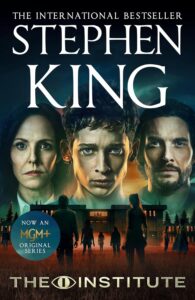
I’m thinking if Stephen King has done it, I’m probably okay.
CH: Sitting on the shoulders of giants.
Oliver Johnson: Yeah. Then Terry Hayes’s book. I am Pilgrim. The big thrillers of the fifties and sixties, the villains were always clear cut. They were the communists, the lefties, bullies or whatever. Hammond Innes, Desmond Bagley, Alistair Maclean, they all fit that kind of concept, don’t they?
Terry Hayes in I am Pilgrim reinvented that. It’s binary in who the good and the bad are. We don’t have that moral sort of equivalence that we are getting, say, in Le Carré, when you don’t even know if your best friend is an enemy.
Hobbies and Current Reading
CH: What are you reading at the moment?
Oliver Johnson: It’s a good question. I don’t know if you saw the third Knives Out movie. There’s a big locked room mystery and John Dickson Carr’s The Hollow Man came up, and, I thought I haven’t read that book.
So I’m reading that right now. It’s excellent. All set in the snow. A locked room mystery: how did this person end up dead in a locked room. Has a bit of a sort of supernatural air about it.
CH: And what do you do for fun?
Oliver Johnson: I used to play cricket, but I’m a bit old for that now. I go for long walks in the country. I’m very interested in film. I play chess. I play these role playing games. I’ve got two cats. But yes, I’ve been very much part of the world of books all this time.
And you make your own fun in your head, don’t you?
